Early History
Hogansville was named for William Hogan, who in the early 1830s owned two of the original land grants issued by the State of Georgia. His holdings encompassed much of what is now downtown Hogansville, including present-day Main Street from Church Street east to Mountville Road, south to near Taliaferro Drive, west toward Brooks Road, and areas surrounding the mill and mill village. Hogan’s property also included the critical crossroads of the north–south Atlanta–West Point Railroad and the east–west road toward Augusta, now Georgia Highway 100.
In the 1840s, when Hogan and neighboring landowners granted right-of-way to the Atlanta–West Point Railroad, Hogan donated 150 feet at the railroad crossroads with the stipulation that a depot be constructed there. This strategic decision laid the foundation for the future town—decades before Hogansville’s formal incorporation in 1870.
After receiving his state land grant in 1826, Hogan constructed a log home near the current mill site along Highway 29. In 1851, he built a brick colonial home, which burned in 1899 and was rebuilt nearby in 1901. Today, a private residence at 703 East Main Street occupies the site. William Hogan died at age 57, leaving six children from his first marriage to Mary and fifteen from his second marriage to Suzanna. His descendants remain numerous in the area. Hogan is buried in a small family cemetery located in front of 705 East Main Street.
After the Civil War
Prior to the Civil War, Hogan sold very little of his land. Following the war, returning soldiers faced a difficult economic environment during Reconstruction. In 1866, Hogan’s son-in-law, John Pullin, laid out the town into business lots, which were sold at an administrator’s sale. Main Street was established as a 60-foot-wide thoroughfare running east and west on both sides of the railroad tracks.
Hogansville was officially incorporated on October 12, 1870, and quickly emerged as a regional center of commerce and the area’s largest cotton market.
Growth and Prosperity
By 1890, the Zachry Building was constructed at the corner of Main and College Streets. The Zachry Brothers’ store occupied the ground floor, selling general merchandise, while an opera house later opened on the second floor. Around 1900, the Grand Hotel was built on the southeast corner of Main and Oak Streets. A local fixture, Bill Dukes, met arriving trains with his ox cart to transport guests’ luggage and famously rang the dinner bell while announcing meals along the hotel’s expansive porches. The Grand Hotel still stands today and has been restored.
Turn of the Century: A Mill Town
For much of its early history, Hogansville functioned as a mill town. In 1897, the Hogansville Manufacturing Company was chartered, and a textile mill was constructed near Yellow Jacket Creek. A surrounding mill village—bounded by Green, Dickinson, Askew, and Johnson Streets—was developed to house workers.
Ownership of the mill changed several times throughout the early 20th century, including Consolidated Duck of Delaware, Lockwood-Green of Boston, Callaway Mills of LaGrange, and eventually Uniroyal. Today, the facility continues operation as Industrial Specialty Fabrics, maintaining Hogansville’s longstanding industrial presence.
The Great Depression
The economic collapse of the 1920s and 1930s brought hardship to Hogansville, particularly with the decline of cotton prices. Federal New Deal programs provided critical assistance during this period. The Works Progress Administration (WPA) constructed the school gymnasium and tennis courts on Main Street, while the Civilian Conservation Corps (CCC) built the Hogansville Amphitheater using stone from a nearby quarry.
Following restoration in recent years, the amphitheater remained a cherished community venue, hosting concerts, performances, and local events.
Hogansville also shared a unique connection to President Franklin D. Roosevelt. Hugh Darden, owner of the local Ford dealership, sold Roosevelt a hand-controlled automobile through chief salesman Joe Broome. The vehicle Roosevelt used while visiting Warm Springs is now displayed at the Little White House.
Post-War Years and Modern Era
Following World War II and through the Korean War, Hogansville experienced a period of prosperity, serving as a commercial hub for northern Troup County and surrounding regions. Main Street bustled with activity, particularly on Saturdays, as shoppers filled the sidewalks.
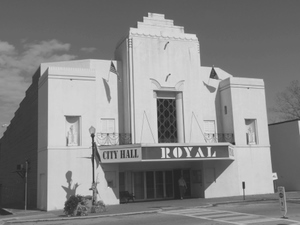
In 1937, the Royal Theater was constructed by O.C. Lam in the Art Deco style. Operated for decades as a movie theater, it became the social heart of Hogansville. After years of vacancy and repurposing—including serving as City Hall until 2021—the Royal Theater was fully renovated and reopened in 2024 as a multi-use venue for live performances, films, and community events.
The rise of automobile travel in the 1950s shifted shopping patterns toward larger regional centers, challenging local businesses. The social changes of the 1960s brought further transition, including the integration of local schools, which occurred with minimal disruption.
Today, Hogansville looks toward the future while honoring its past—reestablishing itself as a center for arts, culture, and community life, and continuing its evolution as a vibrant small city within the region.